Where Bitcoin Becomes Money First
Circular economies are where Bitcoin is demanded by the people who produce wealth in a place. These are the places where Bitcoin will evolve fastest and the first that will become Bitcoin-first.
 By Charlie
· 9 min read
The problem with having no meter stick
Every government on earth is spending more than it takes in, and the gap between the two, the deficit, is most often covered like this: the government borrows, and when it can't find enough people willing to lend to it (buy its bonds), the central bank steps in and lends it the money, created from nothing. That's the trick. A government that can print never has to say no to itself. Nobody votes for this. It just happens, year after year, because once a currency costs nothing to create, there is nothing to stop it being created non-stop.
There is a cohort of people who get to benefit from the newly created currency. A lot of politics is focused on who gets what share of the redistributed wealth that arises from tax and inflation. These are promises by governments to the people, and promises that will have to be paid for out of the future productivity of the citizens.
That is what we are living in, and it is accelerating. Savings erode, prices drift, and everyone is forced to speculate just to stop the money they have saved from losing its purchasing power. It leaves a low hum of anxiety that most people can feel but can't put their finger on. The sharp ones go looking for a better money, one with unchangeable rules.
Bitcoin is that money. Twenty-one million, fixed, and every new coin has to be paid for in real energy through mining. Nobody owns the clock, and nobody can shorten the second. It doesn't need to be popular or pretty. It just needs to not move, and it doesn't. The people who see this unchangeable money early, and work out how to earn it, spend it and build the tools that make it useful, are the ones who'll set the terms of what comes next.
How a thing becomes money
Money doesn't arrive all at once. It climbs three significant steps.
First it becomes something people believe is worth collecting. A store of value. You put your work into it and trust it will purchase something of worth in the future. Bitcoin has already done this part. Hundreds of millions of people hold it for exactly that reason, and most of them have never spent a sat.
Second it becomes something people accept for their goods or services. A medium of exchange. This is the crucial step, the one that gives money its moneyness and reduces the reliance on other currencies to do the exchanging. It's not enough for me to hold Bitcoin. The baker has to want it, and the baker's supplier has to want it, and the fella who fixes the baker's oven has to want it. Otherwise the money leaves the cycle, gets sold for euros at some point, and whoever bought that Bitcoin stores it away.
Third it becomes the thing people count in. A unit of account. Rent is quoted in it. Wages are agreed in it. Nobody converts in their head anymore. That is the finish line. A lot of people who have saved in it for a while already value their wealth as "how much Bitcoin do I have?" Next comes "how many sats for the house on the corner?"
Here's the thing though. These steps don't happen everywhere at the same speed. They happen in pockets first. Somewhere, a small enough group of people get far enough along step two that step three starts showing up in the contracts between them. That pocket is called a circular economy, and it's the most important thing happening in Bitcoin right now.
What a circular economy actually is
A circular economy is a physical place where sats go round instead of out.
That sounds simple, and the first half is. Plenty of places have a few shops that take Bitcoin. A tourist pays in sats, the shop owner converts to euros that evening, and that's the end of that cycle. The sats touched the place and left. That's a payment rail, not an economy.
The second half is what matters: the people who own those shops, and the people who work in them, and the people who supply them, also live there and also hold Bitcoin. So the café owner doesn't convert. She pays her coffee roaster in sats. The roaster pays the lad who does his website in sats. The lad buys his lunch at the café. Nobody had to leave the loop.
When that loop closes, the sats are conserved inside the space. They stop being something you cash out and start being something you keep because you'll need them on Tuesday. The money is now doing both jobs at once, store of value and medium of exchange, in the same pocket, with the same people. And once enough people are doing that, the third step arrives on its own. Someone offers a job paid in sats. Someone rents a flat in sats. A contract gets written with a bonus denominated in sats.
That's the whole thing. Not an app, not an exchange, not a conference. Real people, in a real place, with real goods, who don't need to leave Bitcoin to live their lives.
Three jobs a circular economy does
A circular economy is doing three jobs at once, and each one matters for a different reason.
It's a life raft. If you hold Bitcoin and nowhere around you accepts it, you are still living on the fiat system's terms. Your sats are a bet, and you're surrounded by fiat. A circular economy is the first place where a Bitcoiner can actually get off the boat. Rent, food, a haircut, a mechanic, a day's work. That's not a small thing. That's the difference between holding an asset that goes up and having a home that accepts your life savings.
It's where new Bitcoiners get made. Nobody gets orange pilled by a chart. They get it when the woman at the fruit stall they've bought from for years says she takes Bitcoin now, and why. Adoption spreads by contact, person to person, shop to shop, through relationships. A circular economy is a dense enough space that those contacts happen every day instead of once a year at a conference. It's the most efficient minting ground there is.
It's where the good habits live. Sovereignty and privacy are not ideas you can hold onto on your own in a world that is built to remove these practices. They need a place and a crowd. In a circular economy you are surrounded by people who run their own nodes, hold their own keys, and know which tools let you spend without broadcasting your life all over the internet. You learn by proximity and contact. Standards go up because everyone around you expects them to. A hundred isolated Bitcoiners each know a bit. A hundred Bitcoiners in the same town know a lot, and teach each other
for free.
Why Europe, why an island, why Madeira
So where does it happen first? Not everywhere. Somewhere specific, and the specifics matter.
Europe is the obvious continent to want it in, and the hardest one to get it in. It’s where a huge share of the world’s history, culture and trade sits. It’s where people actually want to live. It is also where the fiat machine is most complete, every transaction tracked, every merchant squeezed on fees, every saver quietly taxed by the printer. If Bitcoin can take root as an economy inside Europe, it can take root anywhere.
An island helps more than people expect. The loop is easier to close when there’s a coastline around it. Suppliers are local because they have to be. People know each other because they can’t avoid it. Money that leaves the island is obvious, and money that stays is felt. Circular is the natural shape of an island economy before you add Bitcoin to it.
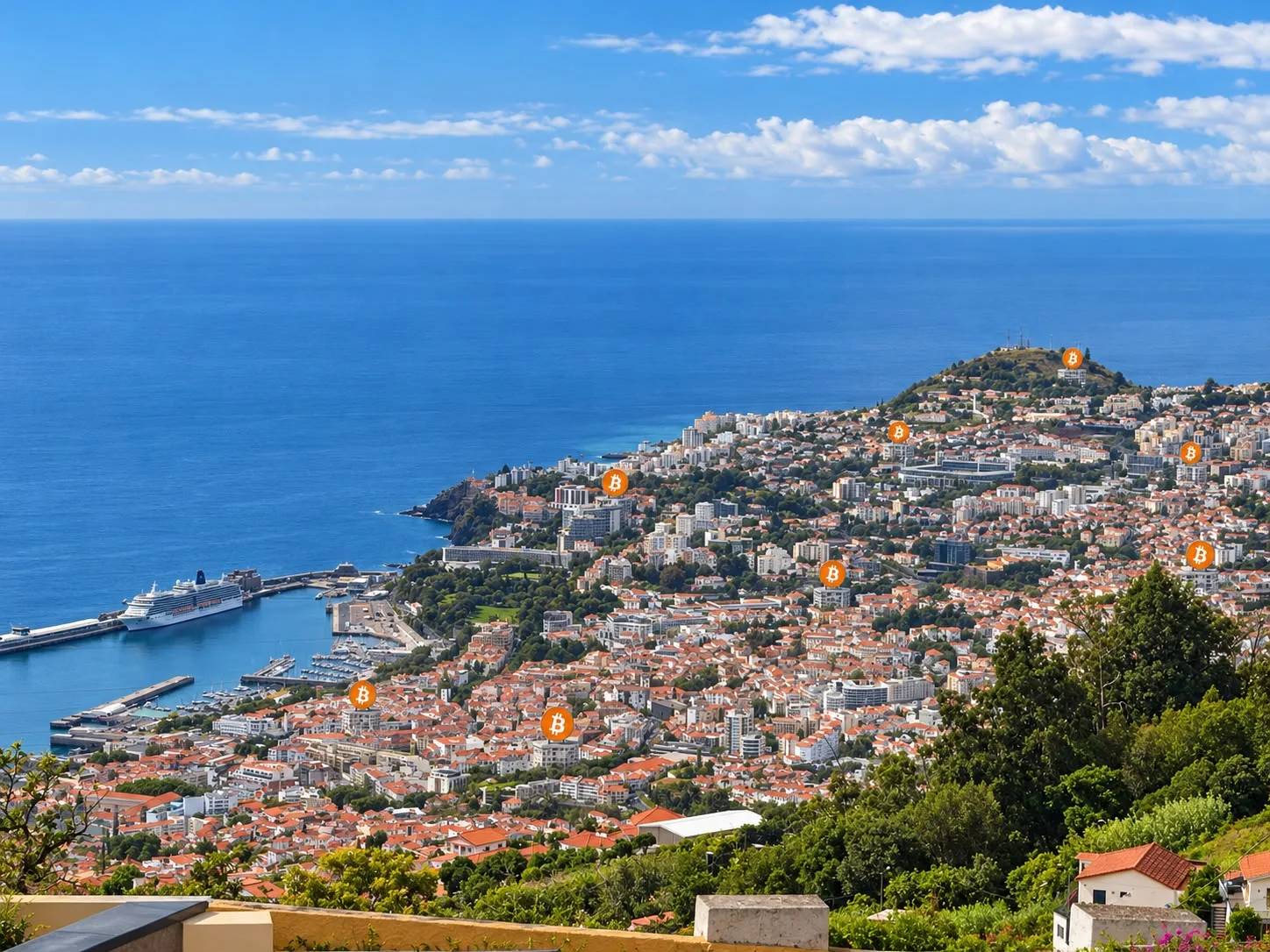
Madeira has all of that, and then something extra: it attracts the right people. Over the last few years it has become one of the places where serious Bitcoin developers, builders and long-term thinkers choose to live and not just visit. They come for the climate and the safety and the pace of life, and they stay because there is a tribe on the ground pushing for the same mission. Today over 160 businesses on the island take Bitcoin over Lightning, there’s a ten-week Bitcoin course running in Portuguese, and a monthly meetup that fills a room without anyone being paid to turn up. There is a growing cohort of Bitcoiner families who have settled here and use Bitcoin every single day. They are building the world they believe will be best for future generations.
That’s the recipe. A high density of people who hold sats, a high density of places that take them, and owners of those businesses who live there too. Add time and low time preference, and that loop will close. Madeira is not a finished circular economy yet. But it is, by a distance, the best-placed one in Europe to get there first, and to become the place where sats are earned, spent, quoted and contracted as a matter of ordinary life.
Where it happens first
Bitcoin becoming the world’s money is not going to happen with a big bang. It’s going to happen gradually, over time, creeping into the way people think.
The global story, the debt, the printing, the slow loss of the ability to measure value in fiat, is very real. And this global story will be settled on a local level, in circular economies. It gets settled in a few dense places where enough people hold sats, enough places demand it for their services, and the owners of the businesses live there. Those places are the front line. Everything else is waiting on them.
If you hold Bitcoin and you’ve been wondering what to do with it beyond holding it, the answer is simple. Find one of those places, or help build one. Spend a sat where it stays. Pay someone in sats who’ll pay someone else in sats. Be the reason a loop closes.
We’re doing that on an island in the Atlantic. Come and see for yourself.
- circular economies
- bitcoin
- austrian economics